 Nuvo Platform
 Nuvo Intelligence
 Customer Onboarding
 Portfolio Management
 Vendor Onboarding
 Accounts Receivable
 Alcohol & Beverage
 Apparel
 Building Materials
 Chemicals
 Distribution
 Food Service
 Heavy Equipment
 Manufacturing



Loading

Every credit application your team approves with incomplete information is a bet, and the longer the verification takes, the worse the odds. Slow manual checks, patchy documentation, and ownership data that lives in three different systems are the gaps where bad debt and fraud find their way in.
Know Your Business (KYB) onboarding is how credit teams close those gaps before a business customer's first invoice ships. Done well, it speeds up approvals for good customers and stops the wrong ones before they reach your accounts receivable (AR) aging report. Done poorly, it shows up months later as compliance findings and write-offs. The difference comes down to whether your framework is actually built to catch what manual review misses.
KYB onboarding sits at the intersection of regulatory compliance and credit control operations. In an ideal state, it's invisible. Applications move through verification quickly, good customers get approved fast, and risk signals get caught before they become write-offs. When it comes up short, it's a bottleneck that:
The operational payoff appears in two common places: speed and control. You approve creditworthy customers faster because you're not waiting on manual reference checks or incomplete applications. And you reduce exposure because your process catches red flags like mismatched addresses, shell companies, and beneficial owners with fraud histories before they become write-offs.
Every day a customer application sits in your queue waiting for verification, you're actively losing revenue.
A prospect who needs $50,000 in net-30 terms to place their first order isn't going to wait two weeks while you chase down business registration documents. They'll find a supplier who can approve them in 48 hours.
The revenue loss is only the visible part. Delayed approvals create cascading operational costs most credit teams don't track explicitly:
The opportunity cost compounds when you factor in customer lifetime value. A construction materials distributor approved quickly might place monthly orders for years. A delayed approval costs you the entire relationship.
When your verification process changes depending on who's handling the application, you're opening regulatory exposure.
One analyst might require three forms of business registration proof. Another accepts a single document. A third skips beneficial ownership checks entirely if the customer seems legitimate. As your customer base grows and your credit team expands, those informal workarounds become impossible to track. You can't audit what wasn't documented. You can't defend a decision that wasn't made according to a repeatable standard.
Inconsistent KYB onboarding creates three specific compliance risks:
The fix comes down to removing human error and variability from the verification layer entirely.
In the discussion of digital vs. traditional credit applications, most credit teams treat manual verification as the safe choice. Call the credit and bank references. Review the documents by hand. Double-check the business registration. It feels thorough. But manual KYB onboarding processes introduce more risk than they eliminate because they rely on inconsistent execution, incomplete documentation, and extended timelines that leave your business exposed.
Manual reviews rely on human judgment, and human judgment relies on complete information. Email-driven Know Your Business onboarding makes it easy for critical documents to go missing, arrive incomplete, or never get requested in the first place.
The most common documentation failures aren't dramatic. They're mundane:
Manual processes don't catch these gaps consistently because there's no enforced checklist. One analyst flags a missing document, another assumes it's on file, and a third doesn't realize it was required.
Automated digital platforms close these gaps by enforcing document requirements up front and flagging incomplete data before it enters your system.
The longer your verification process takes, the more time fraudsters have to exploit it. Manual KYB processes create a dangerous paradox: The thoroughness that's supposed to protect you actually opens a window for sophisticated fraud.
Shell companies age into legitimacy during extended reviews. A fraudster submits an application with a newly registered entity, and by the time you follow up three weeks later, that shell company has a longer operational history and a basic web presence.
These bad actors using compromised business credentials also drip-feed information, testing what gets flagged and what passes through. And as your team juggles dozens of applications, the longer one sits in the queue, the more likely verification steps get abbreviated to clear the backlog.
Automated KYB checks and onboarding collapses that fraud window. When verification happens in minutes rather than weeks, the perpetrators lose the ability to adapt. Real-time checks against business registries, beneficial ownership databases, and credit signals mean you're making decisions on current data, not information that's been gamed during a time-consuming manual review cycle.
A KYB onboarding framework is the operational backbone that determines whether you catch fraud before it costs you, whether you approve good customers fast enough to keep them, and whether your credit decisions hold up under regulatory requirements and scrutiny. Three core layers need to work together: business registration validation, beneficial ownership screening, and ongoing monitoring.
This is where you confirm the business exists as a legal entity and matches the information your customer provided. You're validating registration numbers, company names, addresses, and formation dates against official registries: Secretary of State filings, D-U-N-S numbers, and tax ID records.
Effective legal entity verification catches:
Automated verification pulls this data in real time from Secretary of State databases and commercial registries, delivering results in seconds instead of days.
Beneficial ownership screening moves from verifying the business itself to identifying the people who control it. In practical terms, this means determining which individuals hold 25% or more ownership or exercise substantial decision-making authority, then checking those individuals against sanctions lists, politically exposed persons (PEP) databases, and adverse media sources.
This layer catches scenarios manual verification routinely misses: a principal with a history of business failures applying under a new entity name or an ownership structure designed to obscure connections to sanctioned parties. Automated platforms pull ownership data from commercial business intelligence providers and applicable beneficial ownership filings, and they cross-reference that data against global watchlists.
Verification isn't a one-time event. The business you verified six months ago might have changed ownership, restructured its legal entities, or accumulated new risk signals that weren't visible at approval. Without ongoing monitoring, your initial verification becomes stale data.
Automated monitoring tools pull real-time signals from:
When a customer's risk profile shifts, such as a beneficial owner appearing on a watchlist or the business filing for bankruptcy, you get an alert before the next order ships. Ongoing monitoring turns your KYB framework into a living system instead of a static checklist, letting you adjust credit limits or flag accounts for review based on fresh data rather than waiting for a missed payment to signal a problem.
The best KYB onboarding process is one your team doesn't have to think about. It runs in the background, catches what matters, and gets out of the way when it doesn't.
Manual document collection is where most KYB processes break down. You send a form, the customer uploads a blurry PDF, someone on your team flags a missing field, and three days later you're still waiting on a legible copy of their business license.
Automated verification pulls information directly from authoritative data sources (business registries, credit bureaus, and government databases), so you're not relying on what the customer remembers to send. When documents are required, the system validates them in real time by:
A fake EIN on a PDF is easy to miss when you're processing 50 applications a week, and an automated check against commercial business databases and Secretary of State records catches it immediately.
When digital credit applications feed directly into automated verification workflows with an application programming interface (API), the entire onboarding process becomes decision-ready rather than documentation dependent.
Not every customer needs the same level of scrutiny. A $5,000 order from a 10-year-old contractor with clean payment history doesn't require the same verification depth as a $500,000 credit line for a newly formed LLC with no trade references. And small business creditworthiness looks very different against enterprise applications.
Risk-based decisioning lets you tier your KYB onboarding based on exposure:
The key is defining those tiers up front. What's your threshold for automated approval? What signals require a second look? When does a customer need to provide additional documentation?
Platforms like Nuvo let you configure these rules so the system routes applications correctly without manual triage, delivering faster onboarding for your best customers and tighter controls where exposure is highest.
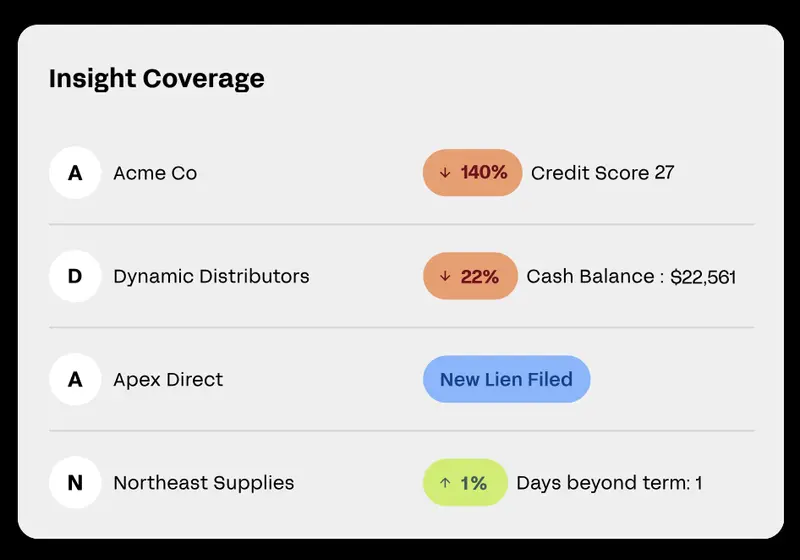
The data you collect during onboarding needs to flow into your ERP, your CRM, and your AR system without manual re-entry.
Without integration, you're creating another data silo. With it, verified data becomes immediately actionable across every system that touches the customer relationship.
Most credit teams know their process takes too long or catches fraud inconsistently, but they're flying blind on the specifics.
Start with the metrics that directly impact your profit and loss (P&L) statement and operational capacity:
Track these metrics at the cohort level, not just in aggregate. Break them down by customer segment, credit tier, and verification method. A 48-hour approval time might look acceptable overall, but if your high-value customers are waiting five days while low-risk renewals clear in six hours, you're leaving revenue on the table. Look for friction points where applications stall or drop off. If fraud detection spikes in certain industries or geographies, your screening criteria need refinement.
Use your KYB onboarding metrics to justify process investments. To build an ROI case for better tools, show how automating beneficial ownership screening cut approval times by 60%, for example, or how real-time business registration checks reduced fraud losses by $250K annually. CFOs care about capital efficiency and risk management. Give them numbers that connect verification performance to both.
Your KYB verification and onboarding framework isn't static. The regulatory landscape shifts, fraud prevention needs evolve, and your customer base changes. What worked 18 months ago might be creating blind spots today.
Start by auditing your current verification workflow:
If verification data lives in spreadsheets or email threads instead of feeding directly into your ERP or credit decisioning system, you're creating manual work that doesn't need to exist.
The biggest shift is treating KYB as continuous, not one-time. You verify at onboarding, then you watch for the changes that move a good customer into a higher-risk tier before the next order ships.
Audit your last 20 KYB decisions against three questions: How long did each take? What documents triggered the most back-and-forth? Where did approvals slip past policy because someone was clearing a backlog?
If the answers point at manual work that needs automatation, see how Nuvo's KYB solution handles business verification, beneficial ownership screening, and continuous monitoring in one workflow.