 Nuvo Platform
 Nuvo Intelligence
 Customer Onboarding
 Portfolio Management
 Vendor Onboarding
 Accounts Receivable
 Alcohol & Beverage
 Apparel
 Building Materials
 Chemicals
 Distribution
 Food Service
 Heavy Equipment
 Manufacturing



Loading

You've approved the customer, sent the invoice, and now you're waiting. The payment that was due 30 days ago is sitting at 45, then 60, and suddenly, your AR team is spending half its week chasing a handful of accounts that should have been straightforward.
If that sounds familiar, the cause sits upstream of the invoice: the decisions about who gets credit, how much, and on what terms. Get those right and your AR team stops chasing accounts that should never have been on the books. That's true credit control.
Credit control is the system a business uses to decide who receives credit, how much they can access, and how the company collects late payments. It covers everything from initial customer vetting to ongoing account monitoring to formal collections escalation. Done well, it produces predictable cash flow instead of a receivables ledger full of uncertainty.
Businesses that extend trade credit without a consistent control framework carry higher days sales outstanding (DSO) and absorb more bad debt than those with structured processes. Every dollar written off as uncollectable already costs you in labor, materials, or overhead. Poor credit control erodes margin on every sale you thought you'd already won.
Credit is a competitive tool in B2B relationships. The goal is to extend it deliberately, to the right customers, under terms your business can sustain.
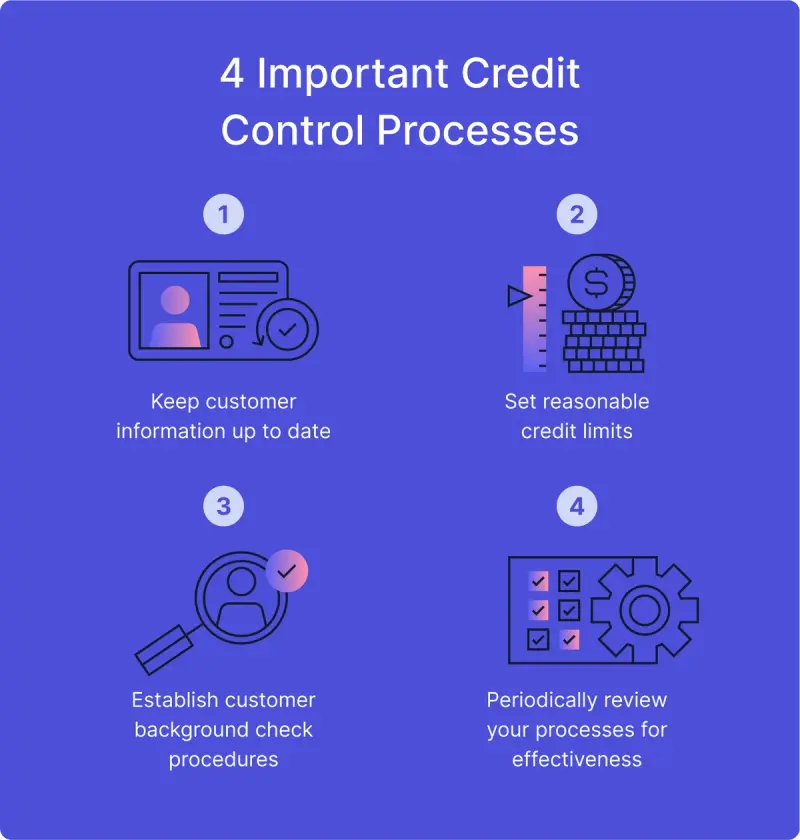
Effective credit control breaks down into four interconnected steps. Each one feeds the next, and skipping any of them creates gaps that show up later as collection problems.
Before you extend a dollar of credit, you need accurate contact details, legal entity information, and decision-maker names.
Verification confirms the legal business name, validates the physical address (not just a registered agent), and identifies who has authority to approve purchases. For subsidiaries or franchises, you need to know who's actually liable for the debt.
Creditworthiness requires a repeatable evaluation process, not a gut call. Define which sources you'll use:
Then, define what an acceptable risk profile looks like. What credit score threshold will you accept? How many trade references do you require? Consistency is everything. If different team members are applying different criteria, you're not controlling credit. You’re guessing.
Even creditworthy customers need boundaries. Credit limits should reflect both the customer's ability to pay and your company's capacity to absorb the exposure. A customer with a strong credit history might qualify for $100K in open credit, but if that represents 20% of your total receivables, you're carrying concentration risk that could hurt you if they default.
Define how you'll calculate initial limits (often a multiple of expected monthly purchases) and establish a review cadence as the relationship matures.
Customer financial stability shifts, payment behavior changes, and your own risk management tolerance evolve as your business grows. Schedule regular account reviews (quarterly for high-value customers, annually for small business accounts) to reassess creditworthiness and adjust limits accordingly.
Look at payment history, DSO trends, and any signals of business stress: leadership turnover, market contraction, or public financial difficulty.
These reviews also give you a feedback loop. If you're consistently writing off debt from customers in a particular industry or size bracket, that's a signal to tighten your approval criteria for similar prospects.
Credit control is the upfront work, like setting standards, running checks, and deciding who gets credit and how much. Credit management happens after, including monitoring accounts receivable, following up on payments, and adjusting payment terms.
In practice, they overlap constantly. Weak control processes make management harder, but poor management feedback means you keep approving the same risky profiles.
The real risk is the handoff between them. If your control process doesn't feed clean, verified data into your management system, you're starting every customer relationship with incomplete information. If your management team isn't surfacing patterns that should change your approval criteria, you're repeating mistakes.
The terminology isn't the point. What matters is whether your processes connect and whether the standards you set at the start actually inform the decisions you make later.
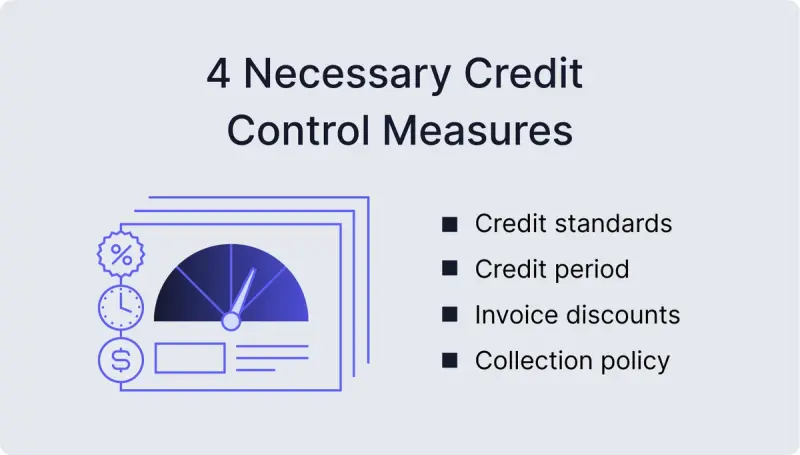
These are the operational levers that determine whether you're chasing payments or running a business.
Vague standards create inconsistent decisions. "Good credit" isn't a threshold. It's a placeholder. Clearly define the specifics. For example:
Most credit teams use a tiered approach: low-risk customers get higher limits and longer terms, medium-risk customers get tighter monitoring, and high-risk customers either get restricted terms or prepayment requirements.
The framework matters less than the consistency. Your team needs to apply the same criteria to every account, not make exceptions based on sales pressure. You can explore business credit score ranges to build a scoring framework that fits your risk tolerance.
Your credit period is how long customers have to pay after invoicing. Net 30 is common, but it's not universal. These are some common breakdowns:
The right answer depends on your cash conversion cycle and competitive landscape, not on what sounds generous. A practical approach: start new customers on shorter terms (Net 15 or Net 30) and extend to Net 45 or Net 60 after six months of consistent payment behavior.
A 2% discount for payment within 10 days (written as 2/10 Net 30) can accelerate cash flow, but only if the math works. That 2% discount for paying 20 days early translates to an annualized rate of roughly 37%. That’s expensive capital if your margins are thin.
Common cash discounts run 1% to 3%, with 2% being most typical. Track uptake rates: If fewer than 10% of customers are taking the discount, it's not compelling enough. If more than 50% are taking it, you may be offering too much relative to the cash flow benefit.
Most credit control policy frameworks fail because they aren't followed consistently. Build a clear escalation timeline:
At 60 to 90 days past due, you need a decision point: debt collection, legal action, or write-off. A common threshold is suspending credit privileges at 30 days past due, with reinstatement only after the balance clears. For balances under $1,000, the cost of collections often exceeds the recovery.
These four measures work together. Tight credit standards reduce the need for aggressive debt collection, while shorter credit periods improve cash flow but may require discounts to stay competitive. The right combination depends on your industry, margins, and working capital position.
The financial case for structured credit control isn't abstract. Companies with disciplined credit processes carry lower DSO, which means more cash available for operations, inventory, and growth. Every day you shave off your DSO is a day of working capital returned to your business.
Bad debt is the more visible cost, but it's not the only one. Slow-paying accounts tie up credit capacity that could be extended to better customers. They consume AR team time that could go toward strategic account management. And they create cash flow gaps that force businesses to draw on credit lines or delay their own supplier payments.
There's also a competitive dimension. Businesses with strong credit control can afford to extend more favorable terms to high-value customers because they know their exposure is managed elsewhere. That's a real advantage in competitive sales situations where terms are part of the deal.
According to AR statistics tracked across B2B companies, businesses that automate and systematize their credit processes consistently outperform peers on both DSO and bad debt rates, not because they're more aggressive, but because they're more consistent.
Most credit control failures happen because sales and finance are operating from different assumptions, and credit is stuck in the middle without clear rules for when to approve, when to push back, and when to escalate.
Your credit policy should be the single source of truth for how credit decisions get made. It needs to cover:
Treat this as a playbook, so your team isn't reinventing the process with every new application.
Sales sees credit as a sales tool, but finance sees it as risk exposure. Get both sides to agree on a few non-negotiables:
A monthly credit review meeting works well. Walk through every account above a set threshold (say, $50K) with both teams present. The goal is shared visibility so both teams work from the same data instead of separate assumptions.
A credit policy buried in a PDF on the finance drive won't get used. Put procedures somewhere your team actually works: a shared wiki, a CRM note, or a section in your ERP. Write it in plain language. "Verify business registration and principal identity before extending credit" is clearer than compliance jargon.
Then track exceptions. If your team is bypassing the credit check process for 30% of new accounts because "the customer was in a hurry," that's a signal your process is too slow, not that your team is being reckless. Schedule a quarterly review to update the policy as your risk tolerance, customer mix, and tools evolve.
Effective credit control comes down to three things:
Document your standards so everyone follows them. Track DSO by customer segment, bad debt as a percentage of revenue, and exception rates in your approval process. Review quarterly and adjust based on what the data shows.
Modern platforms like Nuvo automate the verification and monitoring tasks that otherwise consume your team's time: pulling credit data, tracking payment behavior, and flagging accounts that need review.
Understanding B2B trade credit automation as a category helps you evaluate specific tools before committing to one.
The goal is a credit control system that runs consistently whether it's a slow Tuesday or the end of a quarter when sales is pushing hard to close deals. Consistency turns credit control from a friction point into a competitive advantage.
See how Nuvo supports finance teams across application, due diligence, decisioning, and monitoring.