 Nuvo Platform
 Nuvo Intelligence
 Customer Onboarding
 Portfolio Management
 Vendor Onboarding
 Accounts Receivable
 Alcohol & Beverage
 Apparel
 Building Materials
 Chemicals
 Distribution
 Food Service
 Heavy Equipment
 Manufacturing



Loading

HighRadius was built for the Fortune 500, and that intentionality shows. Global deployments routinely run three to six months of configuration, and pricing scales with every module you add. For a mid-market credit team that needs faster approvals and clearer risk signals, that's a lot of platform to buy and a long wait before any of it pays off.
The full order-to-cash suite solves problems most credit teams don't have yet, while the problem they do have, getting a new customer verified, decisioned, and set up to order, sits inside a much larger and more expensive package.
This guide compares six alternatives that credit and accounts receivable teams actually shortlist against HighRadius, covering what the platform does well, where it falls short, and the kind of team it fits.
Credit managers evaluating HighRadius alternatives consistently hit the same three obstacles:
Focus on fit, not feature count. Standalone platforms built around customer onboarding and credit decisioning accelerate approvals for verified customers. Credit modules inside broader suites manage credit as part of a full receivables operation. Choose the one that matches your bottleneck.
Each entry covers an overview, core capabilities, one or two limitations, and a best-fit use case, with a note on where it sits on the onboarding-to-suite spectrum.
Nuvo is the AI-native order-to-cash platform built around customer onboarding for B2B companies in physical goods industries. Rather than starting from collections and working backward, Nuvo starts at application and verification and connects that intake to decisioning and accounts receivable in one system.
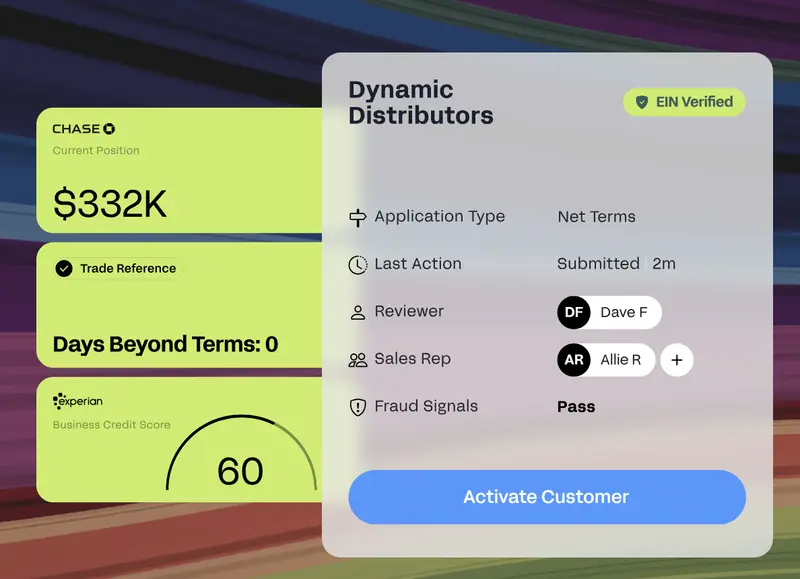
Limitations: Purpose-built for B2B trade credit and physical goods industries, not consumer lending. Initial configuration is required to map your credit policy and connect existing systems.
Best for: Mid-market and enterprise B2B teams whose constraint is onboarding-to-approval speed, and who want onboarding, decisioning, and AR in one system rather than a credit module bolted onto a suite.
Billtrust offers credit management inside its broader AR automation platform, connecting credit application intake to invoice delivery and payment collection downstream.
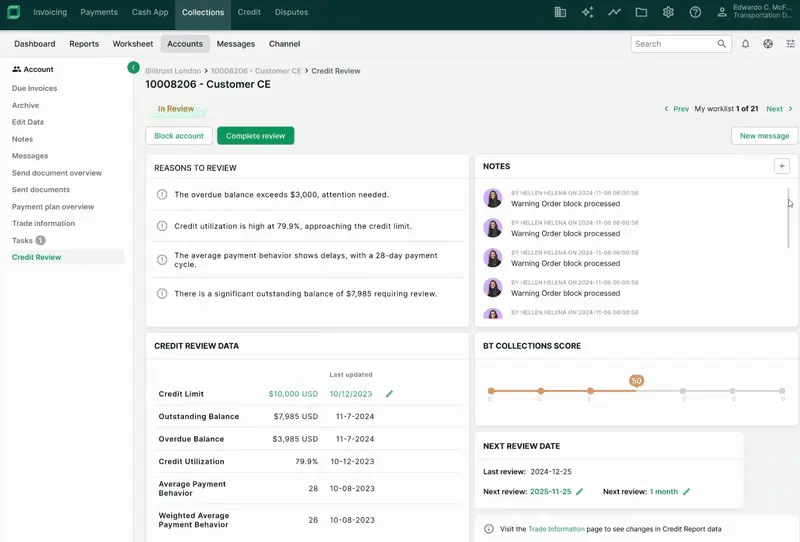
Limitations: Credit features work best inside the full Billtrust AR suite, and credit policy customization can be narrower than a standalone platform.
Best for: Mid-market and enterprise companies already on Billtrust for AR who want credit decisions centralized in their invoice-to-cash workflow.
Esker provides credit management as one module within its AR automation platform. It sells O2C modules à la carte, so the credit module can be bought on its own, though the platform is built for enterprise-scale operations.

Limitations: Built for enterprise-scale operations, which can feel heavy for mid-market teams that need lightweight credit decisioning rather than a full AR overhaul.
Best for: Companies already using Esker for AR, or enterprises pursuing a comprehensive O2C modernization.
Quadient AR, formerly YayPay, focuses on data-driven collections and cash forecasting. Its strength is analytics that use payment behavior to prioritize accounts and predict when customers pay.

Limitations: While Quadient includes credit-management capabilities, its strongest differentiation is in collections automation, forecasting, and receivables analytics rather than onboarding-first credit workflows.
Best for: Finance teams that prioritize collections automation, cash-flow forecasting, and receivables visibility, especially when credit management is part of a broader AR strategy.
BlackLine is best known for financial close and accounting automation, and offers AR automation that uses machine learning to manage receivables and reconcile payments into the ERP.
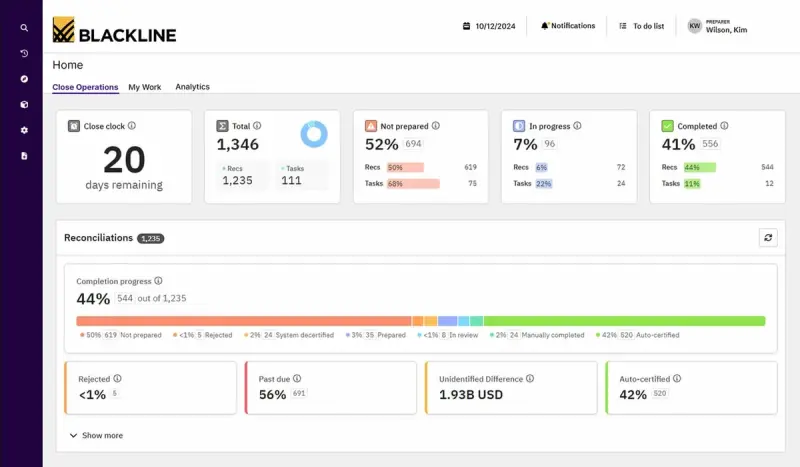
Limitations: While BlackLine includes credit and risk management capabilities, its heritage and strongest differentiation remain in finance automation, cash application, and receivables operations rather than onboarding-first credit workflows.
Best for: Enterprise finance organizations that want AR automation tied into a broader financial close platform.
Invoiced is an AR automation platform for small and mid-market teams, covering invoicing, payment collection, and receivables workflows with a lighter footprint than the enterprise suites.

Limitations: Focused on invoicing and collections rather than credit application intake, verification, and decisioning, so credit-onboarding depth isn't its strength.
Best for: Small and mid-market teams that primarily need invoicing and AR automation without enterprise complexity.
The features that matter map to where your credit team loses time. Four capabilities do most of that work.
A platform that takes three to six months to configure delays every benefit it promises. For a team trying to fix approval speed this quarter, time to value is one of the most important features. Look at how long it takes to run a live application through the system, not just a full enterprise deployment.
Verification done at the application either protects you or hands risky accounts an open line. The strongest platforms pull verification automatically while customers fill out the form. Others leave it as manual reference work afterward.
This matters more each year as new-business fraud rises:
Manual trade reference collection is the other major bottleneck. According to NACM's 2024 B2B credit insights report, reference response time is the primary barrier credit managers face. Platforms that automate reference requests eliminate the step that stalls most approvals.
If credit limits and customer data don't flow into your ERP automatically, someone re-enters them by hand, which means two copies of the truth and a standing source of errors.
Ask whether the platform originates approved customers directly in your ERP or just exports a file that someone imports later. Bureau data works the same way. Pulling reports at submission beats logging into a separate portal for every applicant.
Many credit and AR platforms integrate with accounting and ERP systems such as QuickBooks, Sage Intacct, NetSuite, Microsoft Dynamics, and Xero, reducing duplicate data entry and helping keep customer and receivables information synchronized.
CRM integrations with platforms such as Salesforce and HubSpot can help customer information flow from sales to credit and AR teams, reducing duplicate data entry and manual handoffs.
A tool that only displays data leaves the decision and the watching to you. The ones worth shortlisting act on it. Effective decisioning does three things:
That last point is where many platforms fall short. A standalone credit tool and a full suite both decide on new applications. They differ in how well they keep watching the account afterward.
Match the platform to where your bottleneck is rather than buying the broadest suite available. Work through it in order:
If your bottleneck is approval speed and verified applicant data, Nuvo's built for that. It centers on customer onboarding software with AR in the same connected system. For teams focused on collections, forecasting, or financial close, the AR-led or suite platforms above are better fits.
The strongest HighRadius alternative removes your specific bottleneck without enterprise overhead you'll spend months implementing. A mid-market team that needs faster, safer approvals is better served by a platform built around onboarding and decisioning than by a full O2C suite scaled down to fit.
Start from the friction you live with, whether that's slow approvals, manual verification, or accounts you stopped watching after approval, and compare a few platforms against your real workflow, including a Bectran alternative or two if dedicated credit tools are on your list.
Skip the multi-month enterprise rollout and approve customers in hours with a platform that unites onboarding, credit decisioning, and collaborative AR in one connected system. See how Nuvo works for your team, or read more on reducing days sales outstanding.