 Nuvo Platform
 Nuvo Intelligence
 Customer Onboarding
 Portfolio Management
 Vendor Onboarding
 Accounts Receivable
 Alcohol & Beverage
 Apparel
 Building Materials
 Chemicals
 Distribution
 Food Service
 Heavy Equipment
 Manufacturing



Loading

Most finance teams track revenue to the dollar but can't predict when it will land. Invoices go out, payments trickle in weeks later, tracked across spreadsheets, ERP exports, and scattered emails. According to Upflow's State of B2B Payments, the median B2B company collects in 56 days, well past Net 30 terms.
The work happens in the gap between sending an invoice and getting paid. Your team matches payments to invoices, chases short pays, and follows up on overdue accounts. As volume grows, the only way to keep pace is manual effort or more headcount. Your days sales outstanding (DSO) climbs while earned cash locks up.
Accounts receivable software automates the reactive work, turning receivables into a managed process. Some handle invoicing and payments. Others run the order-to-cash cycle from setup through collections. What’s right for you depends on volume, billing, and systems.
The platforms below fall into three groups:
Where each sits matters as much as features. It determines what customer context the AR work can draw on. A dedicated tool inherits whatever data other systems provide. A suite offers breadth at enterprise cost. A platform with onboarding and credit starts collections with context that the others must import, making it the better choice for B2B trade credit.
Nuvo's AR Suite is a full accounts receivable platform covering payment processing, cash application, collections, discrepancy resolution, and ERP sync. The work runs on Nuvo Intelligence, a set of AI agents that reconcile cash, resolve short pays, and track payments around the clock, so your team's time goes to the accounts that need their judgment. Because Nuvo handles onboarding and credit on the same platform, those agents act on full customer context rather than just an aging report.

Limitations: Purpose-built for B2B trade credit, not consumer billing or subscription revenue recognition. Initial configuration is required to connect your ERP and map workflows.
Best for: B2B distributors and manufacturers that want a full AR product where AI agents run cash application and collections on context from onboarding and credit. Nuvo's Trade Graph spans 150,000+ verified businesses with payment and risk context.
HighRadius offers AR automation inside a broad order-to-cash suite aimed at large, high-volume finance organizations, with depth across cash application, collections, deduction management, and credit management.

Limitations: Priced for enterprise budgets, with implementation timelines that frequently run three to six months.
Best for: Large enterprises with complex O2C operations that want AR integrated with the full receivables cycle.
Billtrust is an AR-focused platform covering automated invoicing, customer portal payment acceptance, cash application, and payment collection, with a track record in distribution and manufacturing.
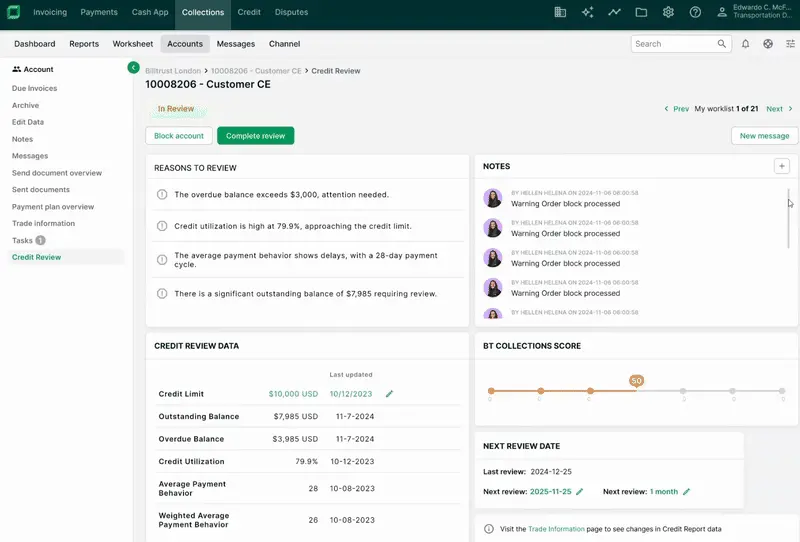
Limitations: Customization for non-standard workflows can require services engagement, and the platform is built for mid-market and enterprise volumes.
Best for: Mid-market and enterprise distributors that want a dedicated AR platform with strong invoice delivery and a payment portal.
Esker offers AR automation as modules within a wider invoice-to-cash process and source-to-pay platform. Teams already using Esker for procurement or AP often add AR to keep the cash cycle on one system.

Limitations: Modules are sold à la carte, so a full AR build can require several pieces, and the platform is oriented toward large enterprise operations.
Best for: Enterprises already standardized on Esker, or teams pursuing a broader source-to-pay and order-to-cash overhaul.
BlackLine built its reputation in financial close and reconciliation and has extended into AR through its invoice-to-cash capabilities, fitting organizations that already run BlackLine for close.
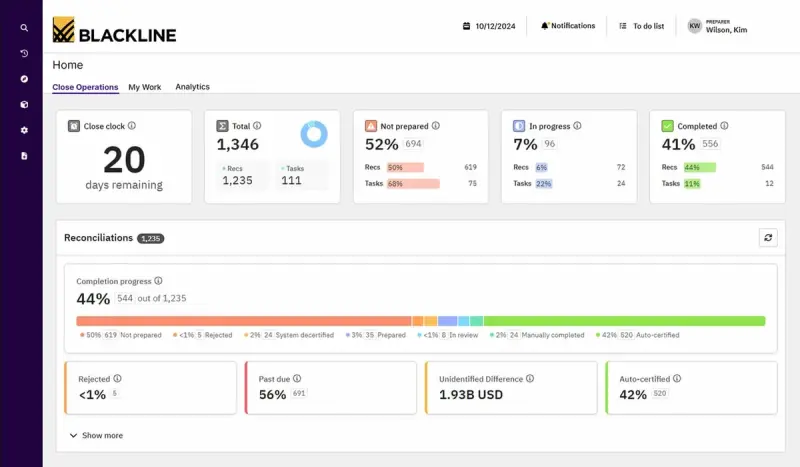
Limitations: AR is an extension of a close-first platform rather than its origin, so teams whose primary need is collections may find the fit indirect.
Best for: Organizations already invested in BlackLine for financial close.
Quadient AR, formerly YayPay, is a dedicated collections and AR automation platform that predicts payment collection timing and sits on top of your existing ERP systems.

Limitations: Focused on collections and AR rather than upstream onboarding and credit setup, so it inherits whatever happens before the invoice.
Best for: Mid-market finance teams that want a collections-led AR layer over an existing ERP.
Versapay combines AR automation with a collaborative model where buyers and sellers resolve invoices and disputes in a shared customer portal, reducing the back-and-forth that delays payment collection.
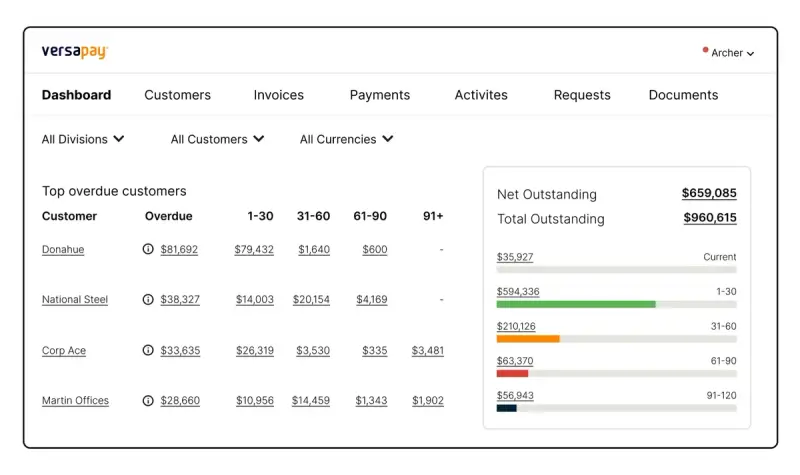
Limitations: The collaboration model works best when customers actively use the portal, and adoption varies by customer base.
Best for: Mid-market companies that want to reduce disputes through a shared buyer-seller workflow.
Feature lists blur together fast. What separates platforms is whether each capability moves DSO, reduces unapplied cash, and sharpens cash flow forecasting, or just digitizes the work.
Easy payment processing is foundational. If customers struggle to pay, everything downstream suffers. Customers need multiple payment processing methods (ACH, card, wire, check) and a branded self-service portal where they pay open invoices directly, eliminating email back-and-forth with your team.
The timing of payment capture matters equally. Collect payment processing authorization at onboarding, before the first invoice, and customers authorize it once. Payments run automatically across all credit structures. When the method is on file as the invoice comes due, late payments drop, and DSO falls.
Cash application creates the most friction in AR workflows. A payment arrives, but the remittance comes separately, or the amount short-pays, or one check covers multiple invoices across divisions. Someone has to untangle it manually before the payment counts as collected. That friction affects your DSO, unapplied cash balance, and forecast accuracy.
Strong cash application removes the manual work:
Nuvo matches payments before they settle in the bank. Your team works with live, current data, so you collect faster, reduce unapplied cash, and forecast accurately.
Collections automation ranks accounts by payment history, risk, and relationship, then sends reminders on a cadence you set. This removes the manual work. Timing also drives results. Sending invoices within 24 hours of delivery cuts DSO by five to eight days, according to Credit Pulse's 2025 DSO benchmarks.
The gap in most tools is the data behind prioritization. Aging reports exported from your ERP are stale by the time your team reads them, so teams end up calling customers about payments already in flight. Nuvo prioritizes live payment behavior and risk from its Trade Graph, giving your team current data to work with.
AR software that doesn't sync with your ERP systems creates a second copy of the truth, and the two start disagreeing immediately. The right system posts payments to your GL, keeps invoice and customer balances current both ways, and reports on DSO and aging without an export first.
Confirm how the integration actually works before you buy. Look for real-time dashboards that show cash flow visibility and current AR status, whether it's a native connector to QuickBooks, Sage Intacct, NetSuite, or another ERP systems vendor.
The right platform depends on your invoice volume, billing complexity, and how it integrates with your systems. Use these questions to narrow down:
Where fragmentation hides is in the handoffs between tools. When onboarding, credit, and AR live separately, invoices stall and customers slip through the gaps. A platform like Nuvo that runs customer onboarding and AR as one order-to-cash network eliminates those handoffs.
Getting this wrong costs more than the software bill. Trapped working capital, manual handoffs, and days added to your DSO add up fast.
Before you book a demo, audit your last 20 invoices from issue to cash. Where did payments get stuck unapplied? Which accounts needed three follow-ups? Where did your team rekey data between systems?
These gaps tell you which capabilities will pay for themselves. If handoffs between onboarding, credit, and collections are costing you, a platform that shares context across all three will move your DSO more than a point tool.
Run onboarding, credit, and AR on one connected system and let Nuvo Intelligence handle the matching, posting, and follow-up. Request a demo to see how Nuvo works.